SQL Primitives
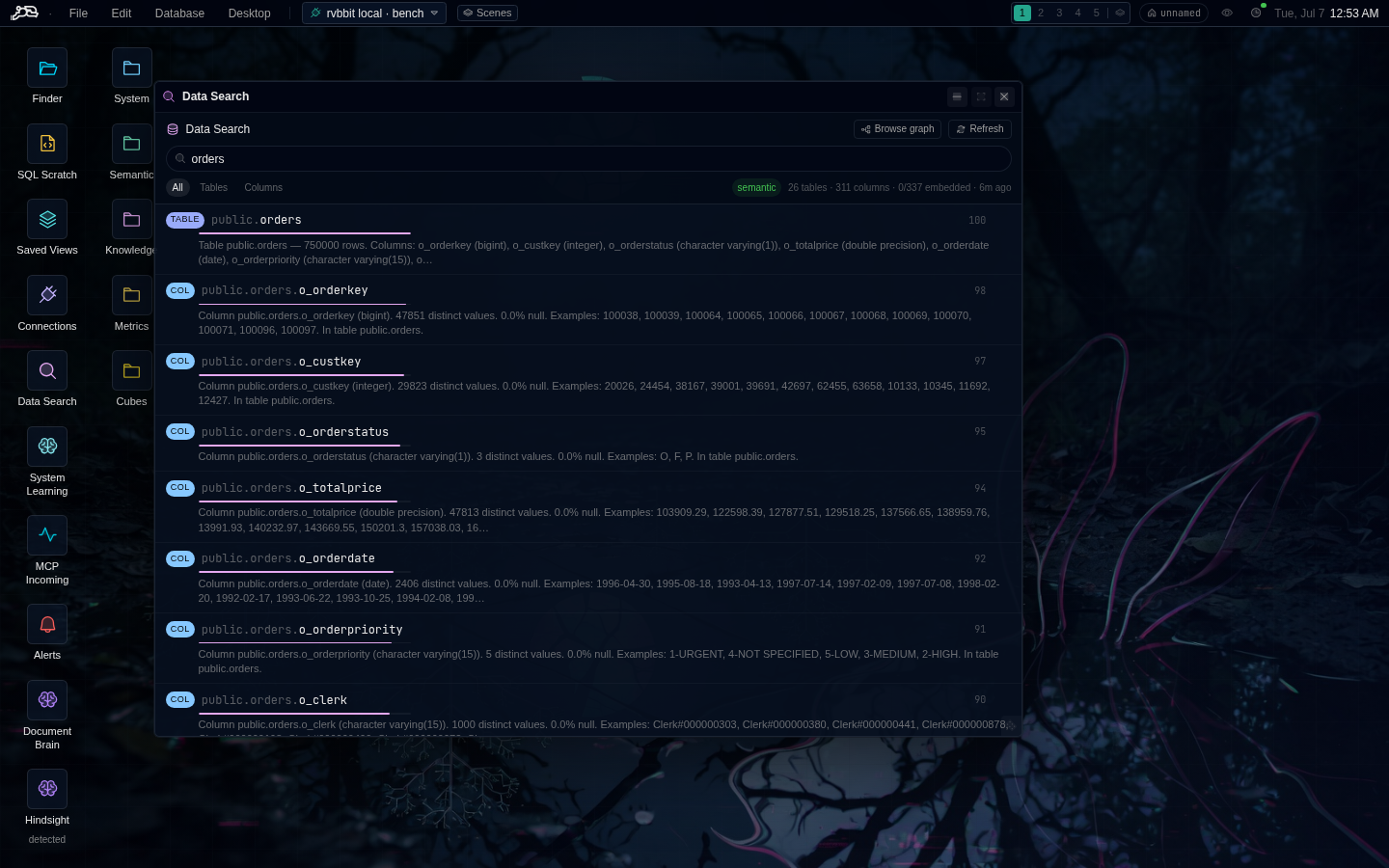
Catalog & Data Search
rvbbit crawls your own database, fingerprints every table and column, builds a knowledge graph plus embeddings, and gives you hybrid free-text search over your data's structure - and run-over-run drift detection - all with zero LLM calls in the base build.catalog_crawl turns your database into a searchable map of itself. It walks
your tables, fingerprints each one (structural stats + example values),
materializes a db_catalog knowledge graph of schemas →
tables → columns (with foreign-key edges), and embeds a deterministic document
per object. On top of that you get data_search - hybrid (dense + lexical)
free-text search over your data's structure - and drift detection that diffs
fingerprint snapshots run-over-run. It works on ordinary heap tables, not just
rvbbit-managed ones, and the base build makes no LLM calls - the fingerprint
documents are deterministic.
Crawl#
The all-in-one form fingerprints every user table (or just the schemas you name) in a single transaction and returns a summary:
SELECT rvbbit.catalog_crawl();                            -- everything
SELECT rvbbit.catalog_crawl(schemas => ARRAY['sales']);  -- one schema
-- → {"run_id": 42, "tables": 127, "columns": 1543, "edges": 2015, "docs_embedded": 1543}
rvbbit.catalog_crawl(
    schemas          text[]  DEFAULT NULL,         -- NULL = all non-system schemas
    graph            text    DEFAULT 'db_catalog',
    sample_rows      integer DEFAULT 50000,        -- TABLESAMPLE above this size
    examples_k       integer DEFAULT 12,           -- example values kept per column
    do_embed         boolean DEFAULT true,         -- false = structure only, no embeddings
    embed_specialist text    DEFAULT ''            -- which embedder (default config)
) RETURNS jsonb
For large databases, prefer the durable procedure: it commits after each table and writes live progress, so a long crawl survives interruption with partial results intact.
CALL rvbbit.catalog_crawl_run(schemas => ARRAY['sales']);

-- Watch it, table-by-table, from another session:
SELECT ordinal || '/' || total AS pos, schema_name, rel_name, status, n_rows, n_columns
FROM   rvbbit.catalog_crawl_progress
WHERE  run_id = (SELECT max(run_id) FROM rvbbit.catalog_runs)
ORDER  BY ordinal;
And the parallel form fans tables across N background workers (via dblink), joining on a shared progress queue. Same progress/results interface - just faster when the embedder can keep up:
CALL rvbbit.catalog_crawl_run_parallel(parallelism => 4);
All three are pg_cron-friendly (a nightly crawl gives you drift history):
SELECT cron.schedule('rvbbit_catalog', '0 2 * * *',
                     $$CALL rvbbit.catalog_crawl_run_parallel()$$);
Search Your Data#
data_search is hybrid search over the fingerprint documents: it embeds your
query once, runs a dense (mean-centered cosine) ranker and a lexical ranker,
and fuses them with Reciprocal Rank Fusion. It degrades gracefully to lexical-only
if no embedder is configured.
SELECT kind, schema_name, rel_name, col_name, round(score::numeric, 3) AS score, doc
FROM   rvbbit.data_search('customer contact info', k => 10);
rvbbit.data_search(
    query text,
    k     integer DEFAULT 20,
    kinds text[]  DEFAULT NULL,        -- e.g. ARRAY['db_table'] or ['db_column']
    graph text    DEFAULT 'db_catalog'
) RETURNS TABLE(node_id bigint, kind text, schema_name text, rel_name text,
                col_name text, score double precision, doc text)
Returns the top-k objects scored [0,1]. An exact identifier (customer_id)
ranks via the lexical side; a fuzzy concept ("who pays us") via the dense side.
Restrict to tables only with kinds => ARRAY['db_table'].
Drift#
Every crawl appends a fingerprint snapshot per object to
rvbbit.catalog_snapshots. catalog_drift diffs two runs and scores each change
- schema changes, row-count/ndv/null-fraction deltas, new/lost categorical
values (PSI), range shifts, even embedding drift - with a
severityin[0,1].
-- Which runs do I have?
SELECT * FROM rvbbit.catalog_runs_list(limit_n => 10);

-- What changed between run 41 and run 42, most severe first?
SELECT obj_key, kind, change_type, round(severity::numeric, 2) AS severity, flags, diff
FROM   rvbbit.catalog_drift(run_a => 41, run_b => 42)
ORDER  BY severity DESC;
rvbbit.catalog_drift(
    run_a bigint, run_b bigint,
    graph text DEFAULT 'db_catalog',
    only_changed boolean DEFAULT true
) RETURNS TABLE(obj_key text, kind text, schema_name text, rel_name text,
                col_name text, change_type text, severity double precision,
                flags text[], diff jsonb)
The flags array names what tripped - rows_up, null_spike, new_values,
dist_shift, type_change, embed_drift, … Filter to one kind of change:
-- Columns whose null-fraction spiked >= 10%.
SELECT obj_key, severity, diff->'null_frac' AS null_frac
FROM   rvbbit.catalog_drift(41, 42)
WHERE  'null_spike' = ANY(flags)
ORDER  BY severity DESC;

-- Low-cardinality columns that gained new categorical values.
SELECT obj_key, diff->'values'->'new_values' AS new_values
FROM   rvbbit.catalog_drift(41, 42)
WHERE  'new_values' = ANY(flags);
A one-line rollup for a header, and a per-object time series for a sparkline:
SELECT jsonb_pretty(rvbbit.catalog_drift_summary(41, 42));
-- { "total": 5, "added": 1, "changed": 4, "max_severity": 0.8, "flags": {...} }

SELECT run_id, captured_at, n_rows, ndv, null_frac
FROM   rvbbit.catalog_object_history('db_catalog', 'sales.orders.status')
ORDER  BY run_id;
What Got Built#
The crawl populates the db_catalog knowledge graph, so
you can query it directly:
-- Biggest tables in the catalog.
SELECT label, (properties->>'n_rows')::bigint AS rows
FROM   rvbbit.kg_nodes
WHERE  graph_id = 'db_catalog' AND kind = 'db_table'
ORDER  BY rows DESC NULLS LAST;

-- The deterministic document used for search/embedding.
SELECT label, d.doc
FROM   rvbbit.kg_nodes n
JOIN   rvbbit.catalog_docs d ON d.node_id = n.node_id
WHERE  n.graph_id = 'db_catalog' AND n.label = 'sales.orders.email';
| Object | Holds |
|---|---|
rvbbit.catalog_runs |
One row per crawl: status, tables_seen, columns_seen, docs_embedded, timings. |
rvbbit.catalog_crawl_progress |
Live per-table progress for the durable/parallel crawlers (ordinal/total, status). |
rvbbit.catalog_docs |
The fingerprint document + embedding per object (table or column). |
rvbbit.catalog_snapshots |
Append-only fingerprint history - one row per object per run. The drift layer. |
rvbbit.kg_nodes / rvbbit.kg_edges |
The db_catalog graph: db_schema / db_table / db_column nodes; has_table / has_column / references edges. |
Notes#
- No embedder? Crawl with
do_embed => false(faster) -data_searchstill works lexical-only. With an embedder, embeddings are cached, so re-crawling unchanged tables is cheap. - Sampling noise - on tables larger than
sample_rows, stats come fromTABLESAMPLE, so small run-to-run drift may be noise. Snapshots recordn_sampledvsn_rowsso you can judge confidence; crawl with a highsample_rowsfor an exact baseline. - Tuning (session GUCs):
rvbbit.search_query_prefix(an instruction prefix for BGE/Nomic-style models),rvbbit.search_dense_floor(raise to be stricter),rvbbit.crawl_dblink_conninfo(the worker connection for the parallel crawler). - The crawl is also the engine behind Data Search, the Scry graph explorer, and Drift views in Data Rabbit.