SQL Primitives
Receipts And Costs
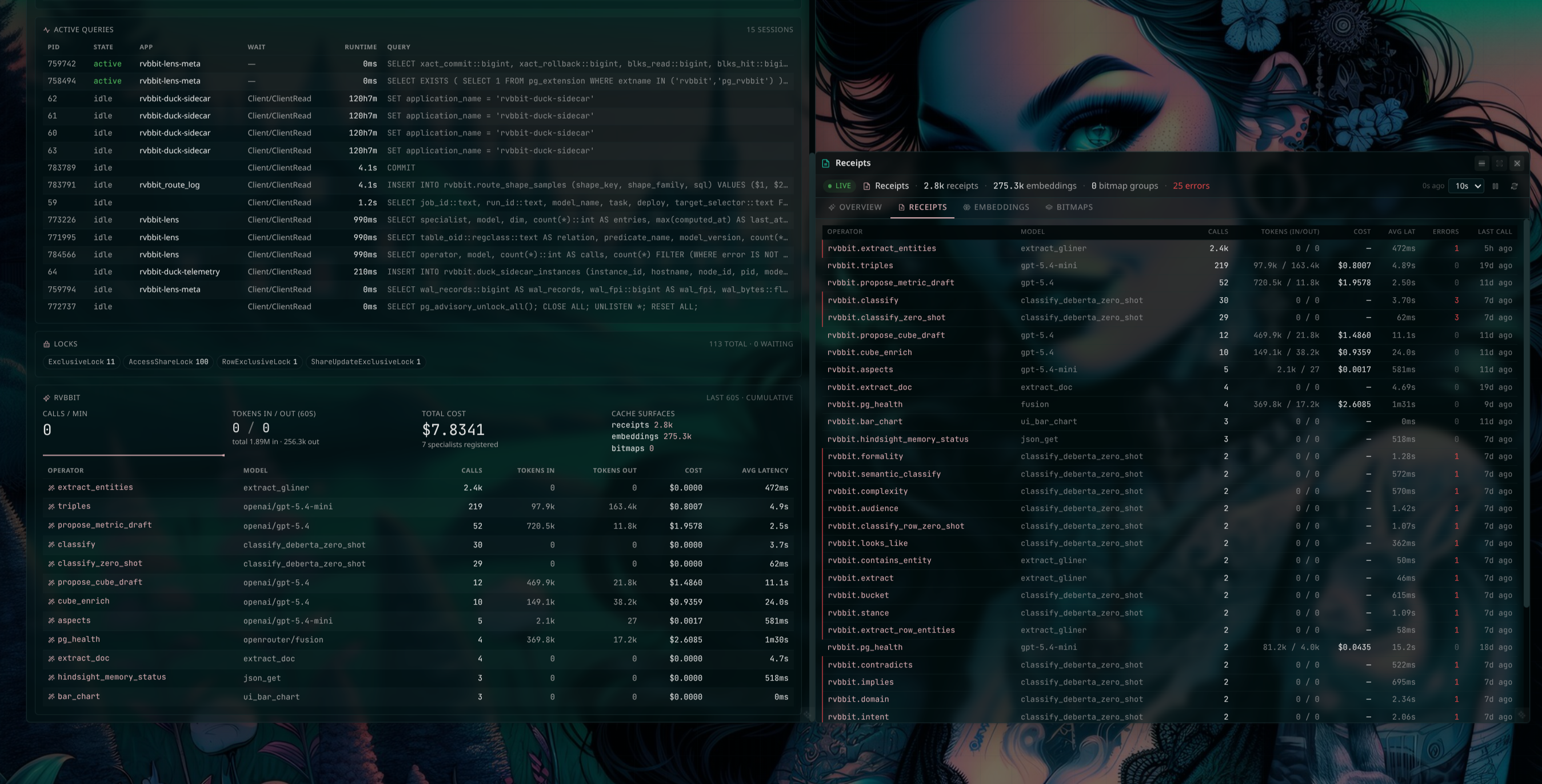
Audit semantic calls, sub-calls, token counts, latency, errors, and provider cost coverage.Receipts are the operational trust layer for semantic SQL. A semantic function can be useful in a demo without receipts; it is not production-shaped until a user can inspect what happened, what it cost, and whether anything failed.
Two Layers#
| Layer | Purpose |
|---|---|
rvbbit.receipts |
One operator invocation, input hash, output, latency, query_id, error, and sub_calls. |
rvbbit.cost_events |
Append-only cost facts for model, specialist, and MCP calls inside receipts. |
Derived views roll those facts up by receipt and query:
SELECT * FROM rvbbit.cost_latest ORDER BY created_at DESC;
SELECT * FROM rvbbit.query_costs ORDER BY last_event_at DESC;
SELECT * FROM rvbbit.receipt_costs ORDER BY last_event_at DESC;
Inspect Recent Calls#
SELECT receipt_id,
       query_id,
       operator,
       model,
       latency_ms,
       error,
       invocation_at
FROM rvbbit.receipts
ORDER BY invocation_at DESC
LIMIT 50;
For richer detail:
SELECT receipt_id,
       operator,
       output,
       sub_calls
FROM rvbbit.receipts
WHERE receipt_id = $1::uuid;
sub_calls is where Cascades expose their internal steps - model (llm)
calls, specialist calls, MCP calls, and code/python steps. The llm,
specialist, and mcp entries are the chargeable ones the cost audit
reconciles against the ledger. Retried attempts accumulate into the same array,
so a retry shows up as repeated sub-call entries on the one receipt.
The operator column holds the operator name - means, about, a classify,
or any user- or pack-defined operator. Built-ins like means() and about()
ship from the BGE reranker capability packs, so their
receipts only appear once the relevant pack is installed.
Per-Operator Rollups#
rvbbit.judgment_stats(op_name) aggregates rvbbit.receipts for a single
operator - invocation counts, unique inputs (distinct input hashes), token and
cost totals, latency, and the first/last call timestamps:
SELECT *
FROM rvbbit.judgment_stats('about');
It returns op_name, n_invocations, n_unique_inputs, total_tokens_in,
total_tokens_out, total_cost_usd, total_latency_ms, first_at, and
last_at. Because each successful call writes one receipt, n_invocations
relative to n_unique_inputs shows how much repeat work the content-addressed
cache has spared.
Correlating One User Query#
All receipts (and KG evidence and cost events) spawned by the same SQL query
share a query_id. Start a fresh trace group with rvbbit.reset_query_id() and
read the current one with rvbbit.current_query_id(); queued receipts may carry
query_id = NULL if the originating context could not safely create one.
Audit Cost Coverage#
SELECT rvbbit.cost_audit_summary();

SELECT *
FROM rvbbit.cost_audit_gaps
ORDER BY invocation_at DESC;
rvbbit.receipt_cost_audit.audit_status is the main status for a UI:
| Status | Meaning |
|---|---|
ok |
Chargeable sub-calls have cost coverage. |
no_chargeable_sub_calls |
Local/free path or no model/tool call was needed. |
missing_cost_events |
Receipt has chargeable sub-calls but no cost rows. |
pending |
Provider has a request id but final cost has not settled. |
stale_pending |
Pending cost has waited too long. |
uncosted |
Call was seen but no pricing policy was available. |
errors |
Underlying semantic/tool call errored. |
Policies#
SELECT rvbbit.set_cost_policy(
  target_kind => 'backend',
  target_name => 'local-vllm',
  policy => 'free',
  notes => 'Local GPU worker'
);

SELECT rvbbit.set_cost_policy(
  target_kind => 'mcp_tool',
  target_name => 'vendor.extract_entities',
  policy => 'fixed',
  fixed_cost_usd => 0.0025
);
Policies can mark local workers free, assign fixed tool costs, estimate from model rates, or wait for provider settlement.
Maintenance#
SELECT rvbbit.receipt_queue_pending();
SELECT rvbbit.flush_receipt_queue(1000);
SELECT rvbbit.backfill_cost_events_from_receipts(10000);
SELECT rvbbit.maintain_cost_audit();
Queued receipts exist because some Postgres execution contexts cannot safely write audit rows immediately. The queue preserves the receipt for a later safe flush instead of dropping it.
What to surface#
Everything you need to observe receipts is queryable from SQL:
- recent receipts and errors,
query_idrollups,- token and latency totals,
- the sub-call timeline,
- missing or pending cost rows,
- maintenance actions for queue flush and backfill.
Treat receipts as audit records - read and aggregate them, but don't mutate them.