Execution
Routing And Training
How RVBBIT chooses heap, native, DataFusion, Duck, Vortex, and trained paths.Routing decides how a normal SQL query should run. The goal is not to be clever for its own sake. The goal is to choose the fastest correct path cheaply enough that routing does not become the bottleneck.
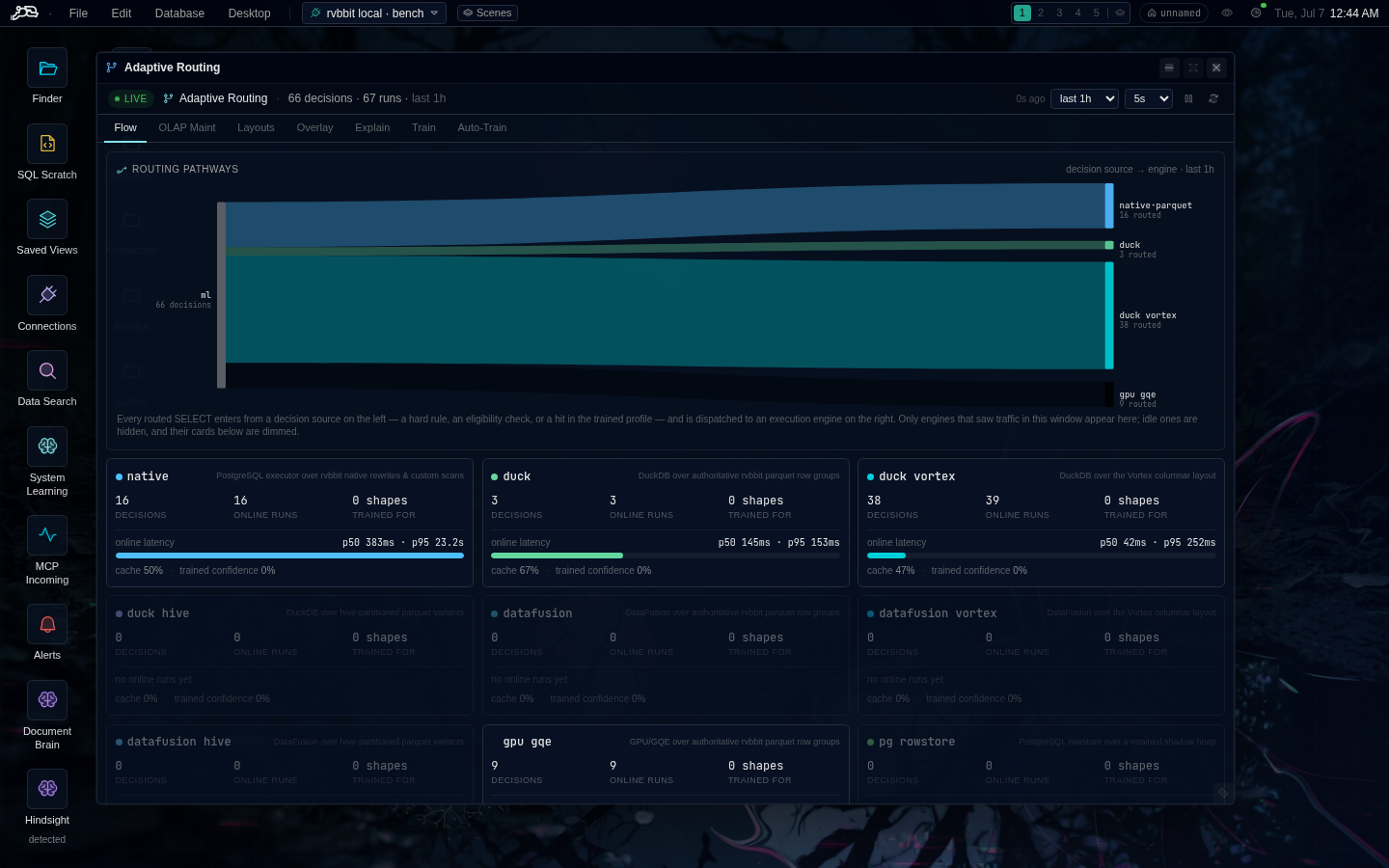
Routing is an optional accelerator. The Postgres heap stays the source of truth, and the default route is conservative: without an active profile, queries stay on the native PostgreSQL/RVBBIT path unless cheap shape rules promote them. The adaptive part is rule- and profile-based. A learned router exists only in shadow mode today - it observes and explains decisions, it does not take over default routing.
Candidate Paths#
Common candidates:
| Candidate (route label) | Typical use |
|---|---|
rvbbit_native |
Always-correct native PostgreSQL/RVBBIT baseline; also the fallback for unsupported SQL. Always eligible. |
datafusion_vector |
In-process DataFusion over authoritative Parquet row groups. |
duck_vector |
DuckDB sidecar over authoritative Parquet row groups. |
duck_vortex |
DuckDB over Vortex-encoded files where they exist. |
datafusion_hive / duck_hive |
Hive-style partitioned Parquet variants for filter-friendly workloads. |
datafusion_mem |
Decoded hot-cache path for small hot tables. |
gpu_gqe |
NVIDIA GQE over authoritative Parquet on GPU hosts - see GPU Execution. |
pg_rowstore |
Retained shadow heap rowstore path. |
The candidate names above are the exact route labels the SQL API uses (the
short aliases native, datafusion, duck also resolve). These storage-backed
candidates are the optional acceleration layer that
sits beside the heap. The heap remains the source of truth.
No-Profile Rules#
When no trained profile matches, the router uses cheap query-shape rules:
- the referenced accelerator data is authoritative and fresh enough,
- query features are supported by a candidate,
- row estimates are within candidate bounds,
- special cases such as time travel or semantic calls are routed to known-safe paths,
- larger analytical scans favor vector or Hive variant paths once the Parquet catalog is authoritative.
Rules describe query shape rather than matching specific queries. The small/simple
native cutoff defaults to 500,000 rows (tune via the RVBBIT_ROUTE_NO_PROFILE_NATIVE_MAX_ROWS
env var or the rvbbit.route_no_profile_native_max_rows session setting); the
variant-first threshold defaults to 250,000 rows. Inspect the live state with
rvbbit.route_status() and a single query's decision with
rvbbit.route_explain(...) or rvbbit.route_explain_text(...).
Training#
Training is SQL-native. One call to rvbbit.route_train_query(...):
- Runs your SELECT once per candidate per repeat, forcing each candidate via a
transaction-local
rvbbit.route_force_candidatesetting. - Digests and validates each candidate's result against the
rvbbit_nativebaseline (row count and an order-aware hash). - Records timings, status, validation status, and the route document for each
candidate into
rvbbit.route_training_queries,rvbbit.route_training_runs, andrvbbit.route_training_results. - Rebuilds the named profile from those validated medians, optionally activating it.
The function signature is:
rvbbit.route_train_query(
  profile_name text,
  query        text,
  repeats      int     DEFAULT 3,
  min_gain_pct float8  DEFAULT 0.05,
  activate     bool    DEFAULT true,
  candidates   text    DEFAULT 'all',
  label        text    DEFAULT ''
) RETURNS jsonb
candidates is a single text value: 'all', or a comma-separated list of
candidate names (rvbbit_native, datafusion_vector, duck_vector,
duck_vortex, duck_hive, datafusion_hive, pg_rowstore, datafusion_mem,
gpu_gqe; short aliases like native, datafusion, duck also resolve). It
is not a SQL array, and rvbbit_native is always included because it is the
correctness baseline.
Example:
SELECT jsonb_pretty(rvbbit.route_train_query(
  profile_name => 'nightly_reporting',
  query => $$
    SELECT region_id, count(*)
    FROM hits
    WHERE event_date >= DATE '2013-07-01'
    GROUP BY region_id
    ORDER BY count(*) DESC
    LIMIT 10
  $$,
  repeats => 3,
  min_gain_pct => 0.05,
  activate => false,
  candidates => 'datafusion_vector,duck_vector,duck_vortex'
));
Training accepts only read-only SELECT/WITH workloads that reference at least
one RVBBIT table, and rejects volatile/time-varying functions (random, now,
generate_series, …) so repeated runs and result validation stay meaningful.
You can rebuild a profile separately with
rvbbit.route_profile_rebuild(profile_name, min_gain_pct, activate), override the
profile for a session with rvbbit.route_use_profile(...), and publish or retire
with rvbbit.route_activate_profile(...) / rvbbit.route_retire_profile(...).
Profiles and their training corpus are ordinary SQL tables
(rvbbit.route_profiles, the rvbbit.route_training_* family, and the
rvbbit.route_profile_summary / rvbbit.route_training_summary views) that you
can inspect, edit, prune, and audit.
The ML Layer and the Self-Training Loop#
Beyond profiles and exact-shape pins, the router carries a per-engine
latency model (small gradient-boosted tree ensembles stored as rows in
rvbbit.route_model, evaluated in-process in microseconds). For queries no
profile or pin covers, the model ranks the eligible candidates by predicted
latency - eligibility stays rule-based, so a misprediction can only cost
speed, never correctness. Fresh installs ship with factory-trained models
(seeded by migration; marked factory-seed in route_model.notes) so
routing is informed from the first query, and any retrain overwrites them.
The loop that keeps the models honest is one call, built for a nightly
pg_cron job:
SELECT rvbbit.route_self_train();
It reads representative SQL captured from your real traffic
(rvbbit.route_shape_samples), replays the hottest shapes across every
eligible engine (unbiased - engines the router currently avoids still get
measured), records timings to rvbbit.route_observations, pins measured
winners, and refits the models. Guardrails learned the hard way: each shape
remembers when it was last tested and is only re-benched after a cooldown
and fresh traffic (rvbbit.route_optimize_retest_hours, default 24h);
per-candidate errors and timeouts are isolated
(rvbbit.route_optimize_timeout_s, default 60s); samples replay under the
search_path they were captured with; and the whole pass is bounded by
top_k / max_seconds arguments. Enable model-ranked routing with
SET rvbbit.route_ml_enabled = on.
Observability#
The routing surface answers:
- What route did this query choose? (
rvbbit.route_explain(query)/rvbbit.route_explain_text(query)) - Which candidates were eligible, and which were rejected and why?
- Was this decision from deterministic rules or a trained profile? The route
document's
route_sourcedistinguishes cases likeno-profile-native,no-profile-datafusion,no-profile-variant, andeligibility. - How did the chosen route perform compared with historical alternatives?
Online routing telemetry is written best-effort and asynchronously into
rvbbit.route_decisions and rvbbit.route_executions, rolled up in
rvbbit.route_runtime_summary. Training results, by contrast, live in the
rvbbit.route_training_* tables. The benchmark harness writes route details into
the training tables; those records are useful calibration data, but they are not
a substitute for production route telemetry.
Correctness#
Fast paths are optional. The router refuses a candidate when:
- the SQL feature is unsupported,
- accelerator files are missing or stale,
- pending deletes cannot be respected,
- a table has a heap tail that the candidate cannot merge,
- time-travel generation state cannot be represented,
- a semantic/operator path would change evaluation semantics.
When in doubt, use heap or another known-correct path.